
The Science of Outdoor Durability: A Material Guide to IMOBILI Sofa Sets
Where Outdoor Sofas Break Down
An outdoor sofa rarely fails all at once. It tends to fail in a familiar order: the cushions flatten, the fabric fades and stains, the frame starts to oxidize, and the tabletop picks up marks. Each failure has its own cause, and each has a material choice that slows it down. This guide isn't a product list—it's the reasoning behind each specification, so you can tell the difference between a claim and something you can actually check. The materials below are grouped by the place they most often fail.
Weave and Fabric: Where Fading and Stains Show Up First
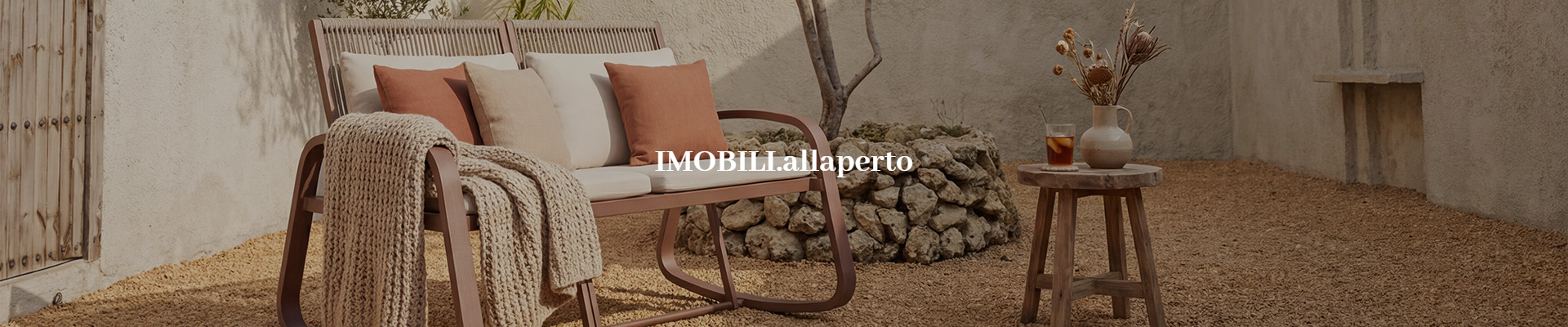
PE rattan looks like natural wicker but behaves differently: natural rattan absorbs moisture, fades in sunlight, and tends to attract pests, while PE rattan is extruded from a formulated polymer that removes most of those weak points. Even so, ultraviolet light breaks down the polymer chains in plastic over time—when that happens, the color washes out and the material turns brittle enough to crack. The main defense is UV stabilizers and color masterbatches mixed in during extrusion, plus testing that confirms how long the material holds up. IMOBILI uses PE rattan that has passed over 2,000 hours of UV resistance testing, and it's also antibacterial and eco-friendly. You can see it on the Corrina sofa, whose terracotta diamond weave sits outdoors in direct sun.
The fabric question comes down to how the color is applied. Piece-dyed fabric is colored after weaving, so the pigment sits on the surface and tends to fade faster and less evenly. Solution-dyed fabric has the pigment mixed into the fiber before it's spun, so the color runs through the thread itself—which is why it generally resists fading, mildew, and stains better. Beyond color, moisture matters too: a cushion that holds water gets heavy and gives mildew a place to grow. Quick-dry construction lets water drain and air move through, so cushions dry out after rain or a pool splash instead of staying damp.
Frame and Tabletop: Oxidation and Water Marks
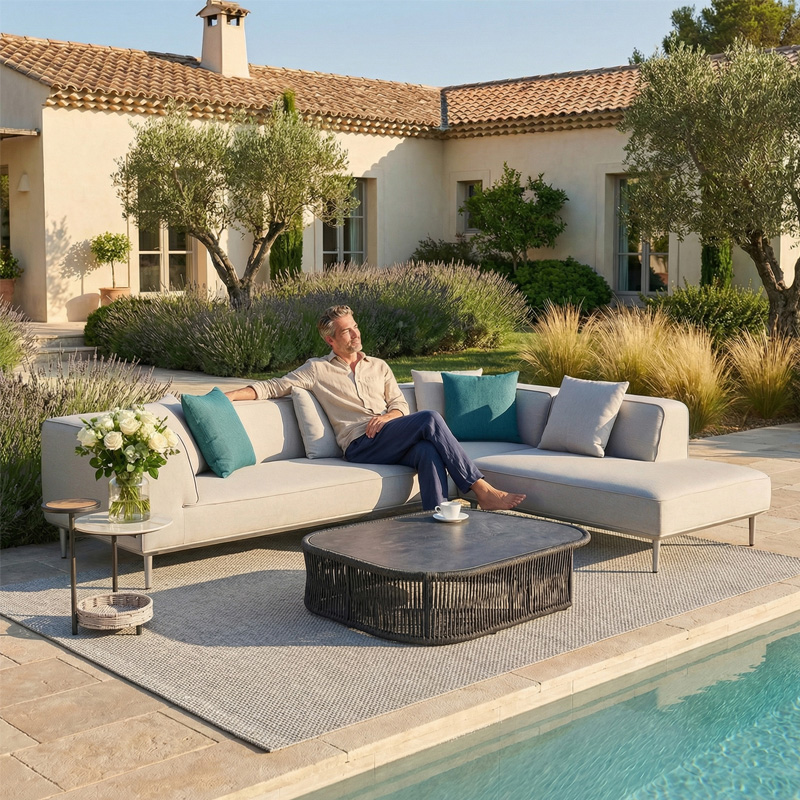
Aluminum doesn't rust the way steel does, but bare aluminum can still oxidize in salt air or around chlorinated water—which is why the frame gets a powder coating. Unlike wet paint, powder coating is applied dry: the powder is electrostatically charged and sprayed onto the metal, then baked until it melts and cures into one continuous film. The result resists scratches, corrosion, and UV exposure, and the process is solvent-free with no VOCs. In a coastal or poolside setting, that layer is usually the difference between a frame that chalks and one that doesn't.
The tabletop is simpler: poolside surfaces face chlorine, water marks, and daily wiping, and sintered stone usually handles that routine best. It resists scratches and stains, and it doesn't hold water marks the way some porous surfaces do. On the Sauna series, sintered stone sits on an aluminum frame with all-weather webbing and quick-dry cushions—a combination designed for hotel pool decks and tropical settings.
Cushion Fill and Teak: Seat Feel and Weathering
The cushion fill is where cheaper outdoor furniture usually cuts corners first. Low-density foam feels soft at first, but repeated compression breaks it down—after a season of daily use it loses its shape and the seat starts to feel like a bench. What matters isn't softness but recovery: how well the foam returns to shape after being compressed. IMOBILI uses a quick-dry foam with good resilience and compression recovery, so cushions hold their shape under repeated use instead of flattening. When comparing quotes, ask about recovery and drainage rather than "softness."
Teak is the exception among outdoor woods. Most hardwoods rot, crack, or warp under moisture and temperature change, but teak relies on its natural oils—they make it water-resistant, give it antibacterial properties, and help it resist the fungus and insects that break down other woods. Teak also resists UV exposure and natural weathering, so it tends to keep its strength and appearance over prolonged outdoor use. The Nordic Breeze series pairs a teak base with rope weaving and an aluminum frame—a good example of teak doing its job without carrying the whole structure.
The Specs at a Glance
| Material | What to specify | The number to ask for | Where IMOBILI uses it |
|---|---|---|---|
| PE rattan | UV-tested, antibacterial | Over 2,000 hours UV | Corrina |
| Fabric | Solution-dyed, quick-dry | Color in the fiber | Across the range |
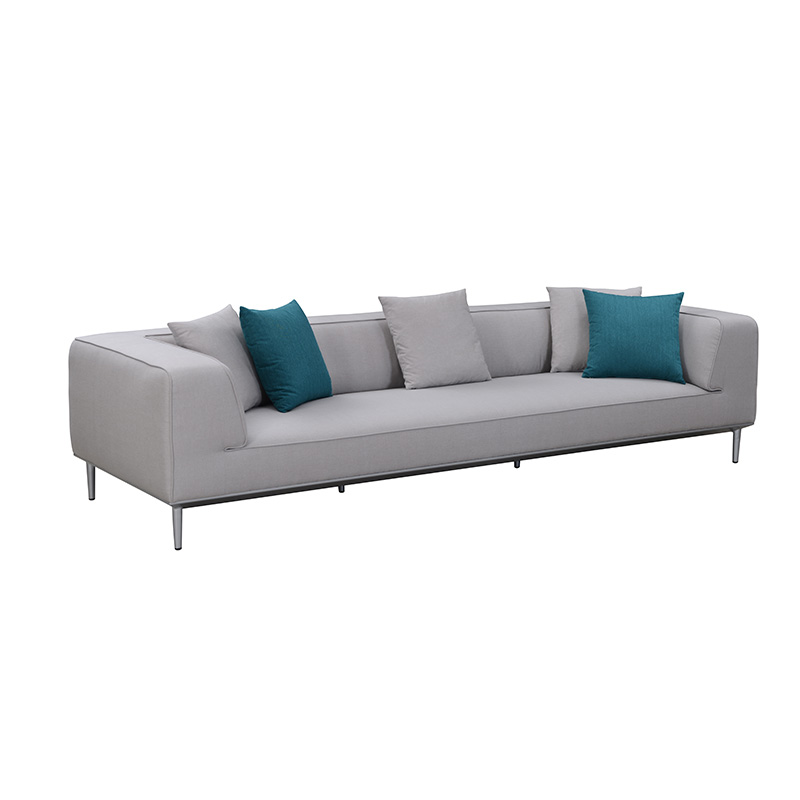
| Frame | Powder-coated aluminum | Scratch/corrosion/UV resistant, no VOC | Sauna, Nordic Breeze, Tuscana Sun |
| Cushion fill | Quick-dry foam | Good recovery under compression | Across the range |
| Wood accent | Teak | Natural oils, antibacterial | Nordic Breeze |
| Tabletop | Sintered stone | Scratch and stain resistant | Sauna |
Mistakes That Shorten the Life
- Choosing foam by softness instead of recovery.
- Accepting piece-dyed fabric when solution-dyed is available.
- Skipping the powder coating on a coastal or poolside frame.
- Ignoring UV testing on the weave.
- Treating teak as if it needs the same chemical treatments as other woods.
FAQ
What's the single most useful spec to check?
The UV rating on the weave—over 2,000 hours is the benchmark to ask for, since UV is what fades and embrittles most outdoor materials.
Why does solution-dyed fabric matter?
Because the color sits inside the fiber, it tends to fade more slowly and evenly than piece-dyed fabric, and it resists mildew and stains better.
Does aluminum need a coating?
Bare aluminum can still oxidize in salt air or around chlorine, so a powder coating is usually worth specifying for those settings.
How do I know the foam will hold up?
Ask about recovery under compression, not softness. Quick-dry foam with good recovery is a sign it's built for repeated use.
Is teak hard to maintain?
Not especially. Its natural oils do much of the weather protection, so it doesn't rely on the chemical treatments some other woods need.
The point of this guide is straightforward: durability in outdoor furniture comes down to a handful of measurable specifications, and each one has a reason behind it. UV hours, solution-dyeing, powder coating, foam recovery, and teak's natural oils are all things you can verify before you order—and they're what tend to separate a sofa that lasts from one that looks right on day one and doesn't on day 365.