
The Design Philosophy of 2026 Outdoor Living Aesthetic
"Color of the Year" and "Single-Season" Both Have Problems
Every year brings a new "color of the year," and furniture that chased the last one tends to look dated quickly. Outdoors the cost is higher: a hotel terrace sofa isn't something you swap easily, so a wrong color can leave a space feeling off for several years, or force an expensive wholesale replacement.
There's a subtler trap too—single-season furniture. It's bought with summer in mind, or winter, and the rest of the year it looks slightly wrong. Most commercial outdoor furniture needs to work across a full year, and a piece that only fits one season tends to look out of place in the others. The 2026 collection starts from both problems: not tied to one year, and not tied to one season.
Neutral Base, Four Seasons
IMOBILI's approach is to make the furniture season-neutral. The base layer is neutral and fixed: powder-coated aluminum and teak, with beige, light grey, white, and black for the upholstery. That combination doesn't feel jarring in spring, heavy in summer, flimsy in autumn, or cold in winter—it largely works all year, with little need to swap for the season.
That's the core of the design idea: the frame is the constant, and the neutral cushions are usually the constant too. Together they form a set that works across seasons. Neutral isn't "no color"—it's more like a base that can hold several seasons at once, which is different from having no point of view.
Why a Neutral Base Is Worth Keeping
A neutral base is worth holding onto when the frame itself is durable. Powder-coated aluminum resists scratches, corrosion, and UV; teak has natural oils and antibacterial properties. These materials can last for many years outdoors, which is why they make sense as the "fixed" part of the design. Neutral cushions, meanwhile, are easy to live with and easy to pair, so they're less likely to look dated even if they stay put for a while.
In a commercial setting, that durability matters twice over. A space that runs on one neutral set avoids both the cost of frequent replacement and the risk of a seasonal color that misses the mark. The neutral base is the part you don't have to think about again.
Seasonal Color: An Option, Not a Requirement
The other side of a neutral base is that it leaves a slot for the season. When a space wants a hint of seasonality, a couple of seasonal cushions are usually enough—but that's a choice, not something the furniture depends on.
| Season | Mood | Optional accent |
|---|---|---|
| Spring | Fresh, waking up | Light beige and grey, slim pieces that open the space up |
| Summer | Warm, energetic | A touch of warm orange, held in check by teak and woven texture |
| Autumn | Cozy, grounded | Chestnut and terracotta tones |
| Winter | Calm, crisp | A soft blue against teak and cool brown |
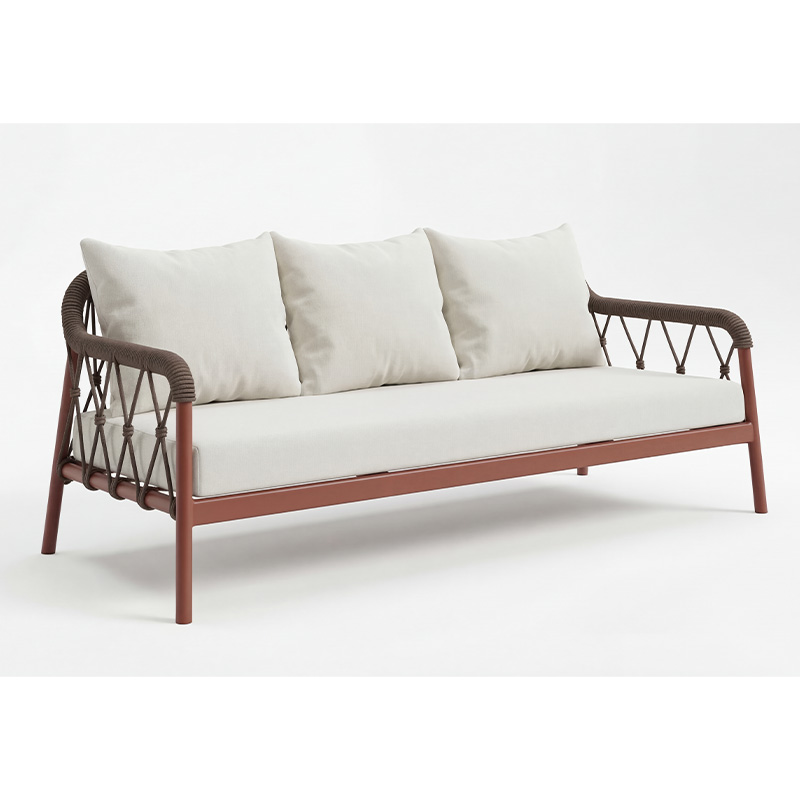
The logic here is that skipping these accents doesn't hurt: the furniture still works across seasons. Adding them simply gives the space a seasonal hint. Terracotta is one of the autumn-winter options—it's the color the Corrina sofa carries on its diamond-weave PE rattan. The rope and woven details do the other half of the work: they soften a strong color, so even a bolder accent rarely overwhelms the room.
One Set, Four Seasons
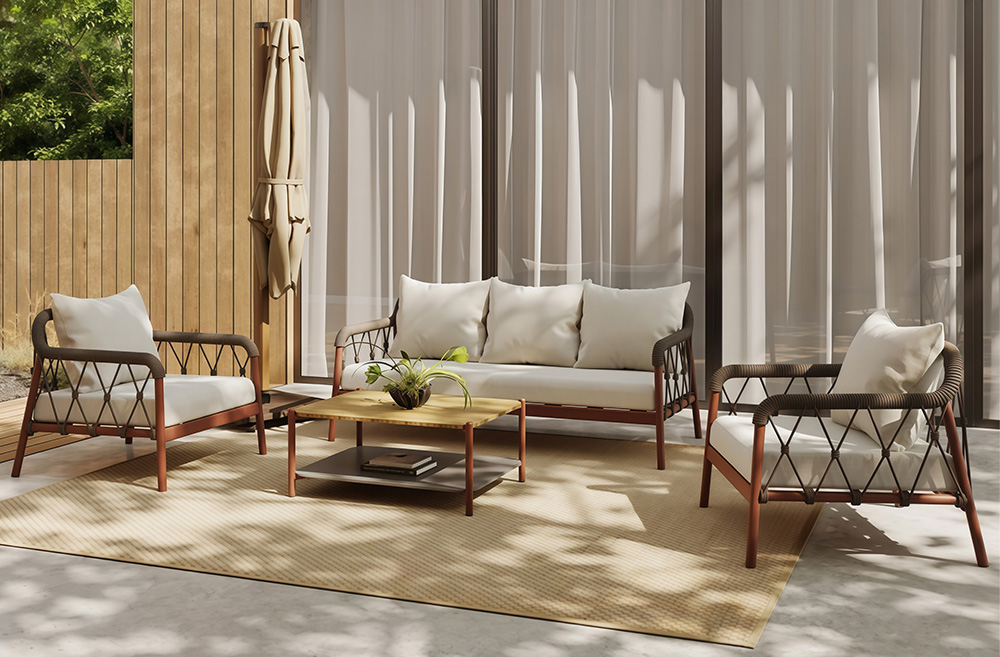
The clearest way to see the idea is to imagine a full operating year. A terrace anchored by the Tuscana Sun sofa—geometric rope weave, a teak tabletop, an aluminum frame, deep cushions, neutral upholstery. In spring it reads fresh; in summer it doesn't trap heat; in autumn it feels grounded; in winter it feels warm. Across the year, the frame and cushions mostly stay put, and the set holds up in all four seasons.
If a particular year calls for a summer campaign, a couple of orange accents work well; if autumn needs more warmth, a chestnut cushion set helps. Adding them is a bonus; skipping them rarely changes how usable the space is. The Macrame cart and a hammock swing sit on the same neutral base, so the accent can run across the whole space rather than landing on a single piece.
How to Refresh When You Want To
Accent-based seasonal changes are usually light work. Order the frame and tables once, keep the neutral cushions in use, and add seasonal cushions as needed, storing them off-season. Covers can be removed and washed, so retiring a color rarely means taking a whole sofa out of service.
For hotel chains, there's a further option: keep one neutral frame and cushion set across all properties, and let individual locations add accent colors to match their season or events. That's a way to hold brand consistency while still giving each property some local character.
Buying for Year-Round Use
At the purchasing stage, the idea translates into a simple order: spec the neutral frame and neutral cushions once for year-round use, and order seasonal cushions only as accents. Brand matching works the same way—colors, fabrics, and weaving can align with a hotel's existing palette, with 3D models, CAD drawings, and renderings to confirm the design before production. The brand identity sits in the frame and the neutral color; the accents follow the season or the campaign.
Behind the color system sit three quieter rules: simplicity, so every line earns its place; comfort, so the seating is drawn for long use rather than short looks; and continuity, so the pieces sit naturally next to interior furniture. Those rules generally don't change with the season—only the optional accent color does.
The Point
The 2026 design philosophy can be summed up as a neutral base, four-season use, and seasonal color as an option. Keep the metal, wood, and neutral cushions quiet so the set works all year; when you want a seasonal change, a touch of color is enough. The furniture doesn't need to be rebuilt, and it doesn't need to be tied to a single season—it's designed for a full year from the start.