
How to Choose Poolside Sofas for a Resort
Poolside furniture operates in one of the most demanding outdoor environments in hospitality. Continuous moisture, airborne chlorine, salt spray, UV radiation, and sunscreen residue act on the materials throughout the season, and specification errors typically surface within a single operating year. The selection process should therefore follow a fixed sequence: classify the pool and its usage level, match each material to the relevant exposure factor, plan the layout around pedestrian circulation, and evaluate total cost of ownership over a three-year horizon rather than purchase price alone.
Classify the pool before selecting materials
Resort pools differ in usage intensity and exposure conditions. Some are family-oriented, with moderate traffic concentrated in morning and evening peaks. Some are club-style and run at high occupancy from opening to close. Others are located on the coast or operate high-chlorine systems, which accelerate corrosion. Each category imposes a different combination of mechanical and chemical stress, so material selection should begin with a classification of the pool rather than a product catalog.
|
Pool category |
Usage intensity |
Material requirements |
Layout recommendation |
|
Family resort pool |
Low to medium, peak-based |
Quick-dry foam cushions, solution-dyed fabric, aluminum frame |
Fixed configuration, separate seating and lounger zones |
|
High-traffic club pool |
Very high, continuous |
Sintered stone tabletop, modular seating, abrasion-resistant fabric |
Modular configuration, reconfigured as required |
|
Coastal or high-chlorine pool |
Highly corrosive |
Powder-coated aluminum, salt-spray resistance, limited steel |
Aluminum-led set, minimal wood components |
Select materials by exposure factor, not by component
It is more reliable to specify materials against specific degradation factors than to follow a generic parts checklist. Each factor maps to one clear material decision.
Moisture ingress is the primary concern for cushions. Upholstery that retains water will develop mildew, which is the fastest way for seating to appear neglected. Quick-dry foam releases water under compression rather than absorbing it, so cushions return to service quickly after exposure. Conventional foam retains moisture, dries slowly, and develops odor within weeks — a defect guests detect immediately.
Chlorine and salt exposure are the controlling factors for the frame. Poolside air carries chlorine, and coastal air carries salt; both corrode unprotected steel within two to three seasons, producing rust that stains the surrounding deck. Powder-coated aluminum provides the required corrosion resistance and reduces handling weight, which lowers labor during seasonal reconfiguration.
Sunscreen residue is the most frequently overlooked factor. The oils in sunscreen penetrate fabric and leave marks that cannot be removed by routine cleaning. Solution-dyed fabric, in which the pigment is integrated into the fiber during production, offers higher stain tolerance and colorfastness than surface-dyed alternatives, which fade unevenly within a single season.
UV radiation compounds the effect of sunscreen. Prolonged exposure bleaches surface-dyed fabric into a patchy, aged appearance. Beyond specifying solution-dyed material, light or patterned colorways provide additional tolerance for gradual fading that solid dark tones do not.
Contact wear and slip safety are the final specification points. Guests move through the area barefoot on wet surfaces, so seating should have rounded edges to reduce impact risk and non-slip feet to prevent movement on wet decking. These details affect both guest safety and the efficiency of daily housekeeping.
Plan the layout around circulation
Poolside layout should follow how people move through the space rather than how the furniture appears in a photograph. The standard approach is wet-dry zoning: position loungers closest to the water and transition outward into the seating area, maintaining a clear circulation path of at least one meter between the zones. This keeps moisture from being carried directly into the seating and provides housekeeping with a safe route through a wet environment.
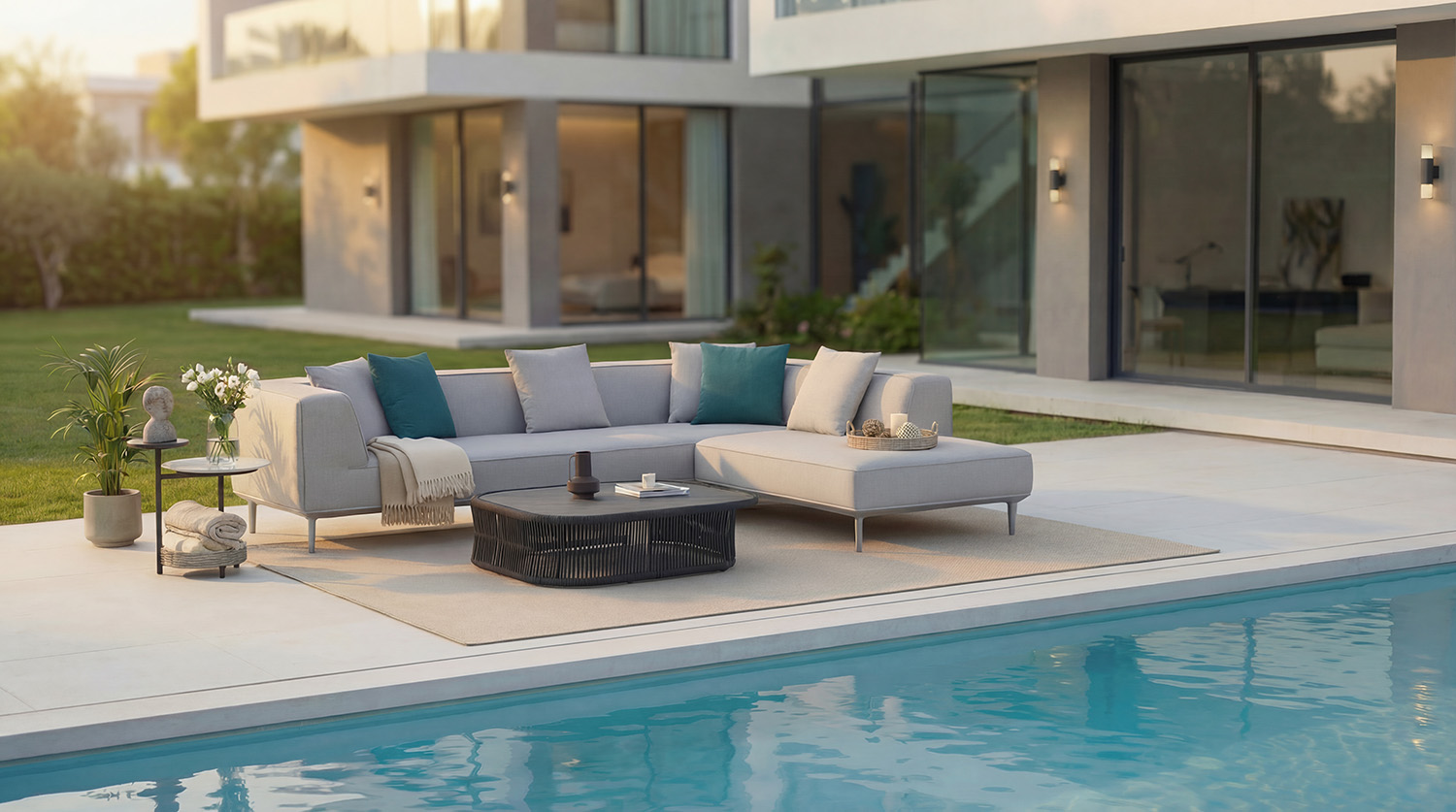
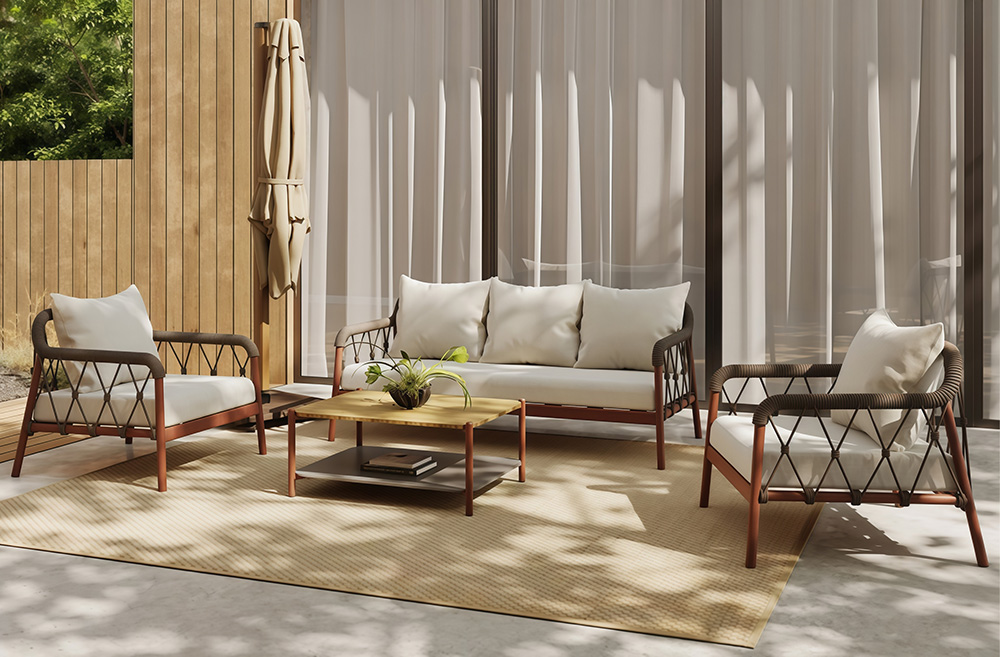
For high-traffic pools, modular seating is the more practical specification. Modular units can be combined into a single extended lounge during peak periods and separated into smaller groups when occupancy declines. The Sauna collection is configured for this requirement, combining modular pieces with sintered stone tabletops for high-use pool decks. For a more relaxed visual character, the rope-woven Tuscana Sun collection provides a softer profile that suits leisure-oriented pool areas.
Evaluate total cost of ownership, not purchase price
The most significant procurement error at a pool is comparing invoice price in isolation. A low-cost set appears economical in year one, then requires replacement when cushions collapse and frames corrode, eliminating the initial saving before accounting for downtime and guest impact. Maintenance labor belongs in the same calculation. An aluminum frame requires no repainting, a sintered stone tabletop cleans in seconds, and quick-dry cushions do not need to be removed for drying. These reductions in labor are recurring savings, and over three years they typically exceed the price difference several times over.
This is the practical case for specifying durability rather than accepting the lowest price. In a poolside environment, material performance is not a premium feature; it is the controlling variable, because any failure mid-season costs more than the difference between a suitable set and an inadequate one.
Confirm the commercial terms before ordering
Once the materials and layout are settled, confirm MOQ, lead time, and warranty before signing, and verify whether the manufacturer can adjust dimensions, colors, and fabrics or apply custom branding. Pool furniture is usually ordered as a configured set under project terms, so delivery reliability matters more than a marginal unit-price difference. Confirm the warranty period, its actual scope of coverage, and the process for resolving frame or cushion failures.
For custom resort or branded projects, review how IMOBILI's customization service handles size, color, fabric, and logo specifications, or contact the team with the pool dimensions, traffic level, and target quantity.